
I recently attended the Mind the Product conference in San Francisco, marking my return after six years. As a senior product leader now, my perspective on product management has evolved significantly: In 2017, I was an individual contributor, essentially a Product Manager II still learning the ropes, and now that I’m a senior director of product, I don’t find talks about “what makes a good product manager” that useful, since I have my own strong opinions about that. While the conference covered various aspects of product management, two talks particularly stood out to me: Aniket Deosthali’s presentation on the AI Product Arms Race and Janice Fraser’s radical approach to leadership, based on her recent book Farther, Faster, and Far Less Drama. Let’s dive in.
Continue readingHow to Use Message Houses in Product Marketing
When I was first introduced to the concept of the message house as a product manager, I saw some value in it, but I found it way too abstract to be useful. Perhaps that’s because I was shown message house templates that look like the following:
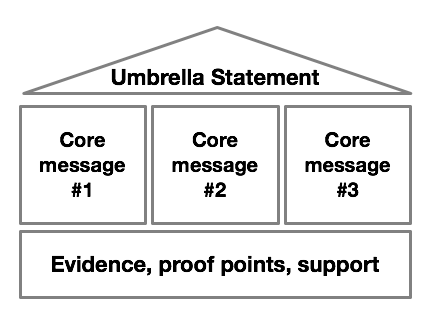
There wasn’t any guidance attached as to when to develop these, what level of resolution they should be at, and more importantly, after the messaging is completed, who should use the completed artifact, when, and for what activities. Unfortunately, many frameworks used in marketing seem to be academic exercises with little applicability to real-world activities. Even if “plans are worthless, but planning is everything”, shouldn’t the plans that are developed count for something, even directionally?
Continue readingIs the Era of Microblogging Over?
In the spring of 2009, I created my first Twitter account. To be completely honest, I didn’t understand Twitter’s utility at first, having previously ridiculed my wife, the early adopter, for wasting time on a tool purpose-built for oversharing-by-text-message. (Remember when you could post to Twitter by texting TWTTR on your phone?) I eventually came to perceive some value in Twitter, though I’m not entirely sure why I got hooked on it even though I had few people to connect to. Perhaps it was because I’d been keeping a blog in some form since 2000 or so (you’re reading it) and so I was more comfortable putting thoughts out onto the Internet with little expectation of response or engagement? Either way, Meredith and I loved the tool so much that we eventually turned our kitchen blackboard wall into a miniature version of Twitter, giving the house an “account” and using the Tweet format to leave messages for one another, as well as imagining observations the house would make if it could. (Mostly about the cats.)
Continue readingDon’t use ticketing systems for product feedback
Sorting through customer feedback on your product is one of the main duties of a PM. Once your product is successful at scale, you will need to move beyond analyzing and responding to individual, discrete pieces of feedback, and trying to find patterns in that feedback: patterns that help you to discern users’ true needs (problems) and not their wants (solutions).
Unfortunately for you as a PM, customer feedback tends to come in the form of solutions. This isn’t to blame users, far from it: that’s the most tangible interface for them, so exhorting users (or even your technical sales team) to “bring problems, not solutions” is unlikely to solve the issue. Defining the problem is your job, not your customers or your SEs.
Continue readingCustomer Feedback and the Art of Selectively Forgetting
If you are currently my customer, and you see the above headline, you might be understandably alarmed. “I spend my valuable time meeting with this guy, and he brazenly admits that he ignores half of what I tell him. Why should I take his call again?” Let me be the first to assure you that this is not what I mean. For one thing, forgetting is not the same thing as ignoring. For another thing, I am actively listening to whatever you are telling me in the moment, and truly trying to analyze and synthesize it. I am also writing down the most substantial or insightful things you say, with pen and paper (because studies show that this physical act, rather than typing out notes, is the best way to retain information). But after that? I probably won’t remember exactly what you said, and I’m definitely not taking immediate action to prioritize anything. That’s because successful product management is about pattern-matching and sense making across a market, not individual customers, and any individual data point, even from our most important customers, might be an outlier. Which leads me to the practice that I call selective forgetting.
Continue readingDemystifying the PR/FAQ
As a product leader, I have been using PR/FAQ in some form with my teams since about 2016. While I’m heartened that there is now a robust body of work describing the artifact, there is much less information about when and how to use it effectively in practice. That is what I intend to convey in this article.
Continue readingWhat’s a Solution vs. a Product?
There’s an overused and overloaded aphorism: words matter. Usually, this phrase is used to state that the selection of words has particular import (true). Yet to a product marketer, the definitions of those words and a company’s alignment around them is much more important. I don’t just mean the terms that you use to market your products (though I’ve had many vigorous arguments about “incident management” versus “incident response” that I’ll save for another day.) I mean the terms that you use inside your company to refer to the various parts of the kit you produce – your firm’s products and solutions. “Products” and “solutions”, though… what the heck do those terms mean, anyway?
Continue readingWhat Tech CEOs and Product Managers Need to Consider Before Entering the US Federal Market
I have now worked at several software companies who have either entered or considered entering the US federal government market. From a distance, this market appears very attractive. After all, the government spends about $90B per year on IT services, an addressable market size that dwarfs private sector IT spending of whole countries. Sometimes, individual solicitations like the (recently-cancelled) $10B JEDI initiative can do so as well.
However, many tech CEOs often make the mistake of assuming that the capabilities needed to service this market are similar to those that need to be developed for pure geographic expansion. Simply hire a sales specialist and you’re done, right? Wrong. Failure to anticipate and build critical product features that are mandatory for successful entry into this market, as well as understanding the peculiarities of the go-to-market capabilities necessary to do so, are the two biggest mistakes I’ve seen when tech CEOs seek to capture US federal government market share.
Below are the various product, marketing, sales, and channel requirements that CEOs and product managers must consider prior to entry so that you do not unintentionally turn that attractive top line into a negative bottom line.
Continue readingHow to Have Effective Trade Show Booth Interactions
I’m returning from my first conference/trade show in over a year. It’s wonderful to be able to hit the road again and meet customers face-to-face. After all, humans are social creatures, and while the last year has brought some interesting innovations in virtual events like wine tastings over Zoom, there really is no substitute for in-person conversation.
I’ve been “working the booth” now for nearly ten years, first as a solutions consultant, and then as a product manager and product marketer. Yet I’ve often noticed that booth conversations between vendor reps and customers can be extremely awkward. It doesn’t have to be this way. Here are some tips for you as an exhibitor to make the most of your customer interactions at the booth, all distilled from advice that I’ve given to sales and marketing teams over the years to prepare them to have effective conversations with customers on the show floor.
Continue readingWhat I Learned from Journalism, As Applied to Product Management
I often get asked for advice from product managers on the skills I consider critical for the role. Invariably, I find myself falling back on some practices that I learned as a journalism student nearly ten years ago. Although I never actually worked as a full-time reporter, I found that basic skills I learned in my very first “craft of journalism” courses are the ones that I now return to again and again as a product leader.
As such, here are the top five things I learned in journalism school that I think are important for emerging product leaders.
Continue reading